WHY THE PROJECT
EXISTS

The Forgotten Art Project grew from something we had noticed for years: whenever our work centred on the male figure, people often wanted to know why. A sustained interest in the developed physique could be treated as unusually narrow, as though it needed to be broadened before it could be taken seriously as an artistic practice.
What kept bringing us back was how much was already present in the body itself. A developed physique cannot tell us everything about the person who built it, but it does reveal that a long process has taken place. Training, repetition, recovery, discomfort, setbacks, patience and time leave visible evidence. Proportion develops. Structure changes. The body begins to carry the history of what was required to build it.
That is what gives the subject such weight for us. Before we know a placing, a sponsor, a follower count or even the person’s name, there is already something worth looking at. The same body can appear commanding, quiet, vulnerable, protective, solemn or exposed depending on how it is held and how we are asked to see it. Its physical development gives light, gesture and pose an unusual clarity.
Yet much of the imagery surrounding bodybuilding asks us to read the physique through competition, products, rankings, sponsorship and social media before we are asked simply to look at the figure itself. The Forgotten Art Project grew from the desire to reverse that order. The body is already there. Our work begins by giving it the space to be seen.
THE BODY AS ARTISTIC LANGUAGE
What holds our attention is how much the same body can communicate through pose. Shift the weight onto one leg and the relationship between the hips, torso and shoulders changes. Lower an arm, turn the head or let one shoulder fall, and the same physique can feel commanding, quiet, exposed or protective.
Developed anatomy makes those changes especially visible. A pose can bring different muscles and lines into view, move tension through the body and change how light describes its form. Even a small adjustment can alter the expression of the whole figure.
This is what interests us as artists. We look at how structure, gesture, balance and light work together, and how those relationships can reveal different sides of the same person without changing who is standing in front of us.

Classical male figure, Musei Capitolini, Rome. Photograph: José Luiz Bernardes Ribeiro / Wikimedia Commons, CC BY-SA 4.0.
Embark on extraordinary adventures with our tailored travel experiences, designed for your enjoyment.
Embark on extraordinary adventures with our tailored travel experiences, designed for your enjoyment.
ARTISTS LOOKED TO THE BODY.
When we began looking backward, we found that the athletic body had once been asked to carry much more meaning than physical achievement alone. In ancient Greece, successful athletes could bring honour to their cities, and some were commemorated through sculpture.
Artists were not simply recording what these men looked like. The athletic figure could be used to give visible form to an ideal. A developed, controlled body could suggest discipline or triumph. Similar physical ideals later appeared in representations of gods, heroes and rulers, where the body helped communicate what those figures were meant to embody.
We would never assume that someone’s appearance tells us his character. What interests us is that the body was once allowed to carry this much meaning. It could show what had been achieved while also pointing toward an ideal. That is very close to what has always interested us about the developed physique.
BENEATH THE SURFACE
Artists eventually wanted to understand more than what could be seen on the surface. During the Renaissance, the study of anatomy became increasingly important to artists trying to understand how the figure was actually constructed. Leonardo da Vinci and Michelangelo are two of the best-known examples, but they were part of a broader interest in studying bones, muscles and the way the body changed through movement.
That kind of curiosity has always made sense to us. The anatomy is already there, but position changes what becomes visible. Raise or open an arm and the serratus can appear more clearly along the ribs. The lat can become more pronounced along the side of the torso, while the pectoral sits differently across the chest. Turn the body and another set of relationships comes forward. Knowing what is underneath helps us understand what we are seeing on the surface.
One of the most important anatomy experiences we had in college came from our teacher Bev Tosh. She took our class to a morgue so we could study the body directly. Obviously, we were not doing what Renaissance artists had done through their own anatomical investigations, but the reason for looking was familiar: if you understand how the body is built, you begin to understand much more clearly why it looks and moves the way it does.
That knowledge changed art, but eventually art would begin influencing the developed body in return.

Leonardo da Vinci, Anatomical Studies of the Shoulder, c. 1510–11. Royal Library, Windsor Castle. Public domain.
WHEN ART BECAME THE MODEL

By the end of the nineteenth century, physical culture had grown into a much larger movement. Strongmen, gymnasts, performers and other developed athletes were already appearing before audiences, and several systems of exercise were beginning to teach people how the body could be deliberately trained. Eugen Sandow was part of that larger world, but he became one of its most recognizable figures and one of the clearest links to modern bodybuilding.
What makes Sandow especially important to us is how directly art entered that process. Classical Greek and Roman sculpture gave him a physical ideal to study. He looked at the proportion and development represented in those figures, trained his own body toward that ideal, and later presented himself through poses that deliberately recalled classical statuary. In performance, lighting and even body powder were used to strengthen the illusion that the sculpture had become a living man.
Sandow also helped turn physical development into something people could pursue systematically. He published exercise programs, prescribed movements and repetitions, sold training equipment and opened Institutes of Physical Culture where people could follow his methods. Training was no longer only preparation for a feat of strength. The body itself could be intentionally developed, balanced and refined.
That distinction helped separate what would become bodybuilding from the strongman tradition around it. Strength still mattered, but the physique itself had become part of the achievement. Proportion, symmetry, muscular development and the way the body was presented could now be judged in their own right. In 1901, Sandow organized the Great Competition at the Royal Albert Hall, one of the earliest major contests built around judging the developed physique rather than simply determining who could lift the most.
This is where the historical relationship becomes especially important to us. Earlier artists had looked at living bodies and translated what they saw into sculpture. Sandow looked back at those sculptures and used them as a reference for developing and presenting a living body. The artistic ideal had returned to the body that had helped create it.
Eugen Sandow, c. 1900. “Brookes & Sandow.” Source: Wikimedia Commons.

Bobby Pandour, physical-culture study, Edmond Desbonnet collection, c. 1920–1930. Public-domain source via Musée National du Sport / PICRYL. Tonal inversion by Bombelkie.
THE ART OF PRESENTATION
As bodybuilding developed, posing became part of the work. Building the physique was one thing. Knowing how to present it was another. A change in arm position could make different muscles and lines more visible. Shifting the weight through the hips could change the balance of the whole figure. Some poses emphasized size and conditioning, while others made proportion, control and the complete shape of the body easier to see.
This was one of the things that drew us to bodybuilding when we were young. Watching Lee Labrada pose on television, we were struck by the transitions as much as the individual poses. One position flowed into the next. The hands, the timing, the way the body turned and came to rest all mattered. The music became the final layer, giving the whole routine another dimension. It was no longer just a sequence of required bodybuilding poses. The transitions themselves became part of the performance.
Later, when we discovered bodybuilders such as Bob Paris, Chris Dickerson, Frank Zane and Serge Nubret, we saw the same attention to presentation in different ways. Their posing had a sense of line, balance and control that made the whole physique feel considered rather than simply displayed.
That is the part of the tradition we keep returning to in our own work. With Carter, the physique is already the subject. Changing the placement of the weight, the arms, the head and the space around him changes how we read the same body. The pose becomes part of what the figure is able to express.

THE FRAME AROUND THE BODY CHANGED


Ali Ejlali at PCA Thailand. Source: 66market / Wikimedia Commons, CC BY-SA 3.0.
Classic Bodybuilding −180 cm winners, 2019. Photograph: Rikard Strömmer / Wikimedia Commons, CC BY-SA 4.0.
Over time, the physique began appearing inside a much busier frame. On a modern stage, it can appear among competition logos, sponsor names, products, prizes, cameras and the larger identity of the event itself. All of those things belong to bodybuilding, but they also compete for attention with the person standing there.
We became especially aware of this through people we photographed ourselves. We knew one bodybuilder with an extraordinary physique who seemed to receive very little attention locally. Then a supplement company sponsored him. His name appeared beside a brand, and suddenly people seemed to treat him as though he had become more important.
What stayed with us was that his body had not changed. The years of training had already happened. The development, conditioning and discipline were already visible before the sponsorship appeared. The company did not create those things. It changed the way other people recognized them.
Competition, sponsorship and social media all have legitimate places in bodybuilding. Athletes deserve opportunities to compete, build careers and benefit from what they have achieved. What interests us is what happens when those outside signals begin telling us who deserves attention before we have really looked at the body itself.
This became one of the central questions behind The Forgotten Art Project. What would we see if some of that surrounding information became quieter and the figure was allowed to stand on its own again?
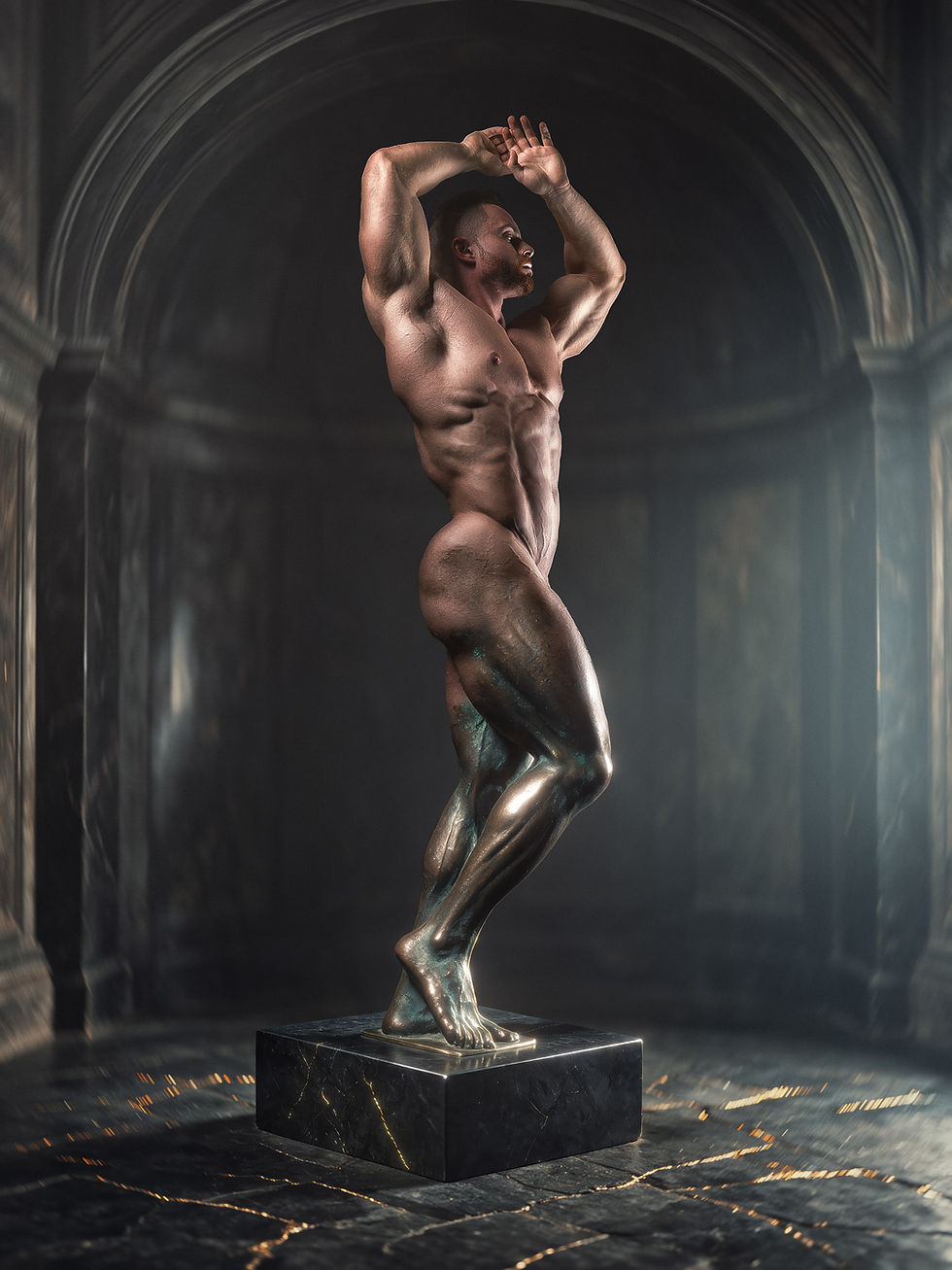
We started using the phrase the Unbroken Line for something we could see before we knew how to explain it. Put posing trunks on a developed body and the figure changes. The waistband cuts across the place where the abdomen becomes the hips and the legs begin. The body is still visible, but the eye no longer travels through it in the same way.
Something else changes with it. The garment starts telling us how to read the image. We see a bodybuilder in posing trunks, or a man in underwear, before we simply see the figure. Without that band, the body can enter a different visual language.
This is why coverage and clothing are different for us. In the Signature Collection, a subject may hold fabric in front of himself while the body is clearly not dressed. The fabric gives privacy, but it does not wrap around the hips or divide the figure at the waist. It becomes part of the composition instead of becoming the thing that explains what kind of image we are looking at.
That difference matters because ordinary clothing carries its own set of rules. Posing trunks place the body back into bodybuilding. Underwear places it somewhere else again. Without either of them, we are able to look at the person and the form he has built before being told what category the image belongs to.
There is also a different gravity to the nude figure. Without clothing, the developed body moves closer to the visual language of sculpture, where the complete form can be seen without being classified first as sport, fashion or underwear. The physique feels more immediate, and the years of discipline carried in it become harder to overlook. There is also something powerful in seeing the figure so unguarded and yet completely composed. Confidence, vulnerability and strength can exist in the same image without cancelling one another out. For us, that is part of the power of the nude figure. It allows the body to stand as the subject of the image in the same direct way it has in sculpture for centuries.
That is what the Unbroken Line means to us. It does not mean that every image has to show everything. Drapery can cover the body and still preserve the figure. What we question is an interruption added only because convention says one must be there. We want to decide what belongs in the image because the artwork needs it, not because the body is considered unacceptable without it.
THE UNBROKEN LINE
THE WORK CONTINUES

By the time we began tracing this history, we started to understand our own work differently. The developed physique had been part of our work for years because it continued to hold our attention. Looking backward showed us that this interest did not exist in isolation. Artists had studied the athletic body, physical culture later looked back toward art, and bodybuilding carried some of that attention forward through posing and presentation.
The people we photograph belong to the present. Their bodies were built in the world we live in now, and each person brings his own proportions and way of carrying himself. We are not trying to recreate an ancient statue or ask someone to become a character from the past. Our starting point is the person standing in front of us.
Photography gives us that foundation. The pose, anatomy and light are established during the shoot. From there, we may change the setting, build architecture, add drapery or construct other elements around what we photographed. The body remains his, and the lighting remains rooted in the original photograph. Everything we add has to work with what was already captured.
That is why we think of The Forgotten Art Project as a continuation. We are entering a much older conversation about how the developed human figure can be looked at, studied and represented through art. Our work does not complete that conversation, and we do not expect it to.
Each person we photograph opens another possibility for what the developed figure can become in an image. One pose leads to another. A shift in weight, a turn of the body or a change in light during the shoot can reveal something we had not seen a moment earlier. That is why it can be difficult for us to stop once a shoot begins. We have only begun to show how much the developed figure can hold.